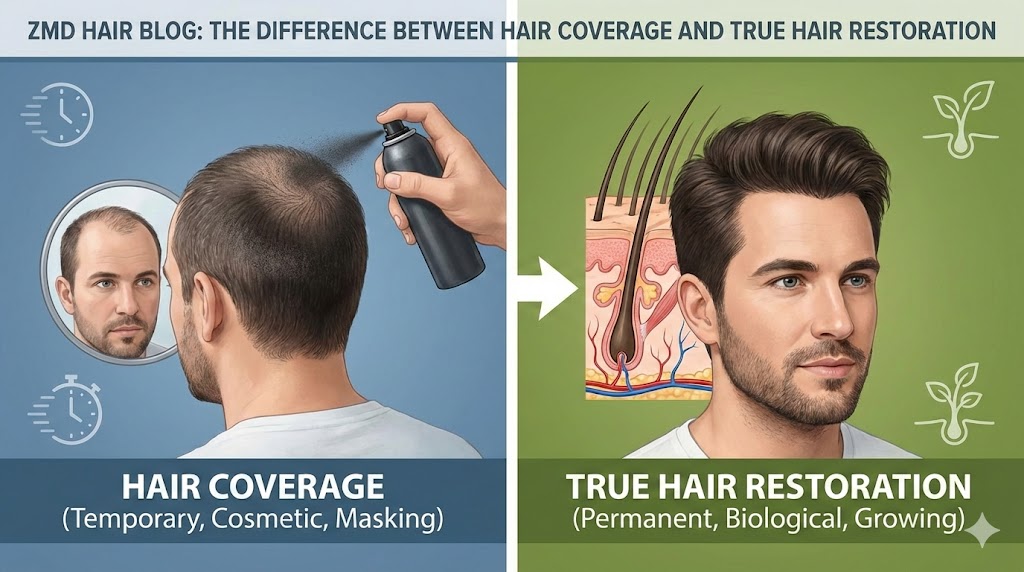
Hair loss has been a significant concern for both men and women. Whether they are middle-aged or young, hair loss affects their confidence, personality, and much more. Hair loss is often treated as a cosmetic inconvenience, but in reality, it is a progressive biological condition that changes over time. For many individuals, especially those seeking treatment in major medical hubs like Los Angeles and Beverly Hills, the challenge is not finding a solution; it is understanding which solutions are temporary and which are truly restorative. The difference between hair coverage and authentic hair restoration is one of the most misunderstood concepts in modern hair loss treatment. While both can improve appearance, only one is designed to restore living hair and deliver lasting results. At ZMD Hair, a flagship site of FUEsion Hair Clinics, this distinction forms the foundation of every treatment plan. Understanding it helps patients make medically sound, realistic, and sustainable decisions.
Why Hair Loss Requires a Long-Term Perspective
Hair loss rarely happens all at once. It develops gradually as follicles miniaturize, growth cycles shorten, and scalp circulation changes. What starts as mild thinning often becomes more noticeable over the years, especially along the hairline, temples, or crown. Because hair loss progresses, solutions that focus only on appearance in the present moment often fall short over time. A result that looks acceptable today may not hold up as the surrounding hair continues to thin. This is where the distinction between coverage and restoration becomes critical.
What Hair Coverage Really Does
Hair coverage methods are designed to improve the visual impression of fullness without restoring actual hair follicles. These approaches can be helpful in certain situations, particularly in early thinning or for individuals who are not candidates for medical or surgical treatment. Coverage works by reducing the contrast between the scalp and the hair. It can make thinning areas less obvious, but it does not change the biology of hair growth. Typical hair coverage options include cosmetic concealers, scalp pigmentation, and styling techniques. While these options may provide short-term confidence, they require ongoing maintenance and become less effective as hair loss progresses.
Most importantly, hair coverage does not prevent further thinning. It masks the condition rather than addressing its cause.
Why Hair Coverage Has Limits
As hair loss continues, coverage solutions face natural limitations. Patients often worry about how long results last and whether ongoing maintenance is needed. Many reach a point where coverage alone no longer provides the confidence they once had. Addressing these concerns by emphasizing the permanence of authentic restoration can help patients make informed decisions about long-term results.
What True Hair Restoration Actually Means
Authentic hair restoration goes beyond appearance. It aims to restore living, growing hair follicles to areas affected by hair loss. This is a medical process that works with the body’s natural biology rather than attempting to disguise changes. In advanced hair transplantation clinics in Los Angeles, authentic restoration is approached as a surgical and medical discipline. It involves careful planning, precise execution, and long-term thinking. Authentic hair restoration focuses on permanence. When done correctly, transplanted hair continues to grow naturally, responds to haircuts, and integrates seamlessly with existing hair.
The Role of FUE in True Hair Restoration
One of the most important developments in modern hair restoration is FUE (Follicular Unit Extraction). This technique allows individual hair follicles to be harvested from donor areas and transplanted with exceptional precision. FUE is not just about moving hair. It is about preserving follicle integrity, respecting scalp anatomy, and placing grafts in a way that mirrors natural hair growth patterns. At ZMD Hair, FUE is used as part of a broader restorative strategy. Each follicle is treated as a valuable, finite resource. Decisions about placement, density, and direction are guided by experience and a deep understanding of how hair grows and ages. This approach is essential for patients seeking refined outcomes associated with hair restoration in Beverly Hills.
Why Natural Hairlines Require More Than Density
One of the most common misconceptions about hair restoration is that success depends on the number of grafts placed. In reality, natural results rely far more on design than volume. Hairlines are not straight lines. They have irregularity, variation, and gradual transitions. Creating a natural hairline requires understanding facial proportions, hair calibre, and future hair loss patterns. Authentic restoration avoids aggressive or overly dense hairlines that may look unnatural over time. Instead, it focuses on balance and longevity. This philosophy is a hallmark of a high-quality Beverly Hills hair transplant and is central to ZMD Hair’s treatment planning.
PRP supports scalp health and ongoing care, helping patients feel reassured that their treatment involves continuous, supportive management rather than quick fixes.
PRP (Platelet-Rich Plasma) plays a supportive role in authentic hair restoration, but it is often misunderstood. PRP does not create new follicles, nor does it replace surgical restoration for advanced hair loss.
PRP improves the environment in which hair grows. It supports scalp health, improves circulation, and may help existing follicles function more effectively. At ZMD Hair, PRP is used selectively. It may be recommended to support early thinning, enhance post-transplant healing, or improve overall scalp condition. Its role is complementary, not standalone.
Advanced Hair Transplant Solutions Focus on the Future
Authentic hair restoration requires planning beyond the immediate procedure. Hair loss does not stop after a transplant, and responsible treatment accounts for this reality.
Advanced planning considers donor area preservation, future thinning, and how transplanted hair will blend with existing hair over time. Patients often worry that future hair loss will affect their results. Emphasizing that responsible, long-term strategies protect against unnatural results can reassure patients about the durability and natural look of proper restorations.
ZMD Hair emphasizes conservative planning and ethical decision-making. The goal is not to use as many grafts as possible, but to use them wisely.
Coverage May Hide the Problem. Restoration Solves It.
Hair coverage can be helpful at certain stages, but it does not change the underlying condition. Authentic hair restoration addresses the root of hair loss by restoring living follicles and supporting scalp health.
The difference becomes more apparent over time. Coverage fades. Restoration grows. Hair loss is a journey, not a moment. The most successful outcomes come from understanding the difference between temporary appearance fixes and authentic biological restoration.
For individuals seeking advanced hair transplantation in Los Angeles or refined hair restoration in Beverly Hills, education is the first step toward lasting confidence.
At ZMD Hair, restoration is approached with care, integrity, and long-term vision, because real results should not only look natural but also remain natural. Every patient is evaluated based on:
- Hair loss pattern and progression
- Donor hair quality
- Scalp condition
- Long-term goals
From there, solutions are customized using FUE, PRP, and advanced surgical planning. This integrated approach ensures results that are natural, durable, and biologically sound.
Frequently Asked Questions
1. What is the main difference between hair coverage and authentic hair restoration?
Hair coverage improves the appearance of fullness by masking thinning areas, while authentic hair restoration focuses on restoring living, growing hair follicles. Coverage is temporary and cosmetic, whereas restoration is a medical solution designed to deliver permanent, natural hair growth.
2. Why is hair loss considered a long-term condition rather than a cosmetic issue?
Hair loss is progressive and changes over time as follicles weaken and growth cycles shorten. Treating it as a long-term biological condition allows for better planning, more natural outcomes, and results that continue to look balanced as hair loss evolves.
3. What makes a Beverly Hills hair transplant different from other hair restoration options?
A Beverly Hills hair transplant emphasizes precision, natural hairline design, ethical graft usage, and long-term planning. At ZMD Hair, this approach combines advanced FUE techniques with careful donor preservation to ensure results remain natural and sustainable over time.
4. Is FUE hair transplantation permanent?
Yes, when performed correctly, FUE (Follicular Unit Extraction) provides permanent results. Transplanted follicles continue to grow naturally, can be cut and styled like normal hair, and integrate seamlessly with existing hair when placed with proper technique.
5. Can PRP replace a hair transplant for advanced hair loss?
No. PRP does not create new hair follicles and cannot replace surgical restoration in advanced hair loss cases. It is best used as a supportive treatment to improve scalp health, enhance healing, and strengthen existing hair alongside a comprehensive restoration plan.