Hairline Lowering Surgery for West Hollywood Patients
A high forehead can affect facial balance and self-confidence in ways that are difficult to address with styling alone. For West Hollywood residents exploring a permanent, surgical solution, ZMDHair offers hairline lowering performed by Dr. Hootan Zandifar — a double board-certified facial plastic and reconstructive surgeon with specialized training in both the structure and aesthetics of the face.
Dr. Zandifar completed his training at UCLA and holds dual certification from the American Board of Otolaryngology–Head & Neck Surgery and the American Board of Facial Plastic Surgery. He is also a member of the American Society of Hair Restoration Surgery, bringing a uniquely comprehensive perspective to hairline procedures. Patients from West Hollywood travel to the practice’s Beverly Hills or Santa Monica office for consultations and surgery.

What Hairline Lowering Surgery Involves
Hairline lowering — also called forehead reduction surgery — is a procedure in which the hairline is surgically advanced forward to reduce the vertical height of the forehead. Unlike hair transplants, which grow new follicles over time, hairline lowering repositions existing hair-bearing scalp, delivering an immediate change in hairline position. The incision is carefully placed at the natural hairline border and is designed to heal with minimal visibility.
The procedure is performed under local anesthesia with sedation or general anesthesia depending on the patient’s needs, and it typically takes one to two hours. Dr. Zandifar’s background in facial anatomy and reconstructive surgery informs every aspect of incision design and tissue handling.
Why West Hollywood Patients Choose ZMDHair
West Hollywood is a community with a sophisticated eye for aesthetic detail, and patients here tend to seek surgeons whose credentials and artistic sensibility match that standard. Dr. Zandifar’s dual board certifications are relatively rare in the field — they reflect rigorous training in both the functional anatomy of the head and neck and the aesthetic principles of facial plastic surgery. This combination is particularly relevant for a procedure as visually nuanced as hairline repositioning.
- Double board-certified by the American Board of Otolaryngology–Head & Neck Surgery and the American Board of Facial Plastic Surgery
- UCLA-trained with deep expertise in facial anatomy
- Member of the American Society of Hair Restoration Surgery
- Offices conveniently located in Beverly Hills and Santa Monica — both easily accessible from West Hollywood
Candidacy and What to Expect at Your Consultation
Hairline lowering is generally suited to individuals with a naturally high or disproportionately large forehead, good scalp laxity, and realistic expectations about surgical outcomes. It is commonly chosen by women seeking forehead reduction, though it may also be appropriate for some men depending on their hair characteristics and future hair-loss considerations. Patients with significant scalp tension or a history of certain scalp conditions may be better served by alternative approaches, which Dr. Zandifar will discuss openly.
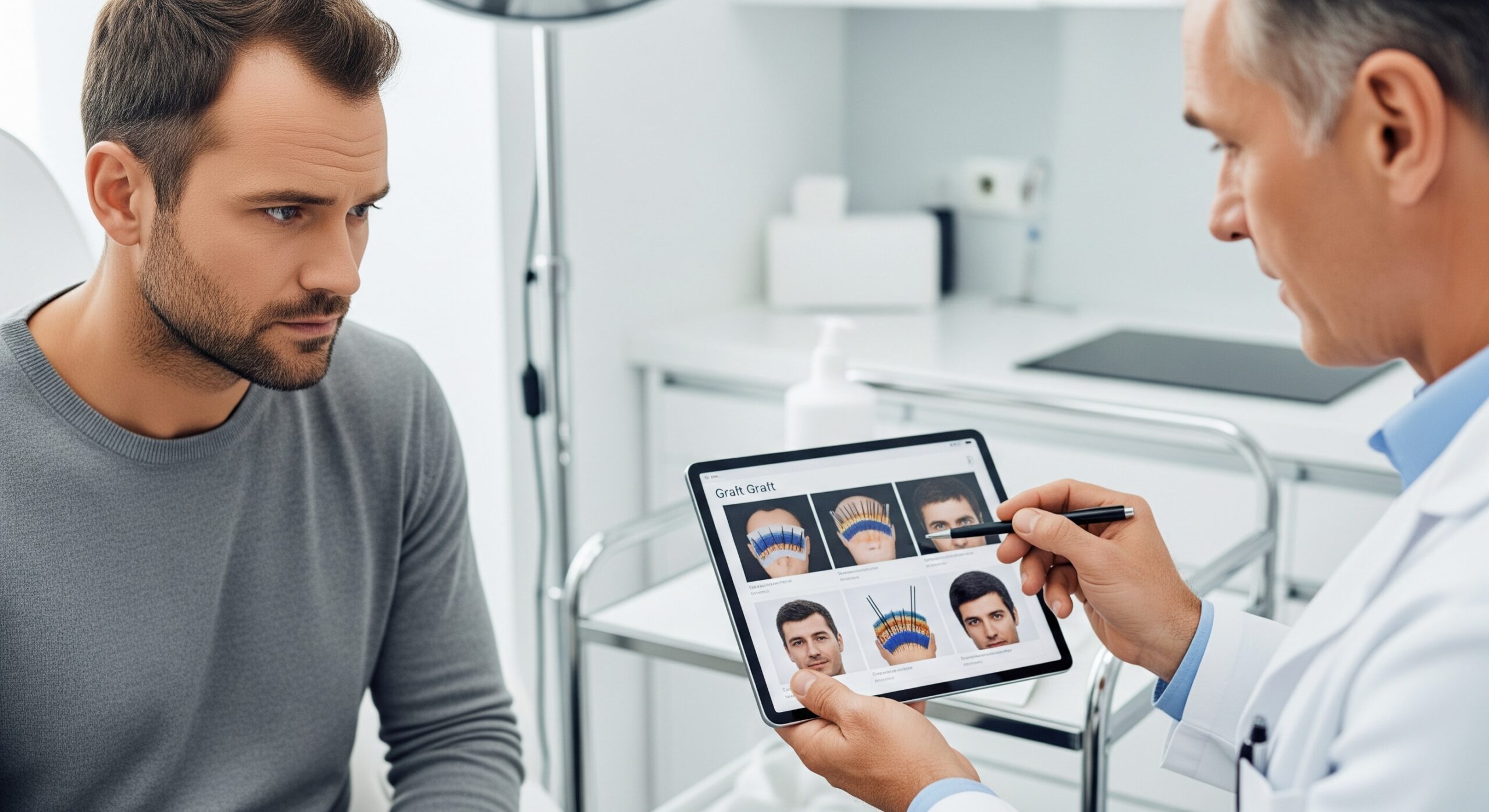
During your consultation at the Beverly Hills or Santa Monica office, Dr. Zandifar evaluates scalp flexibility, hairline shape, facial proportions, and your personal goals. He will explain the procedure in detail, outline realistic expectations, and help you determine whether hairline lowering, a hair transplant, or a combination approach is most appropriate for your situation.
Recovery and Long-Term Results
Most patients experience mild to moderate swelling and some tightness in the scalp during the first week following surgery. Sutures are typically removed within one to two weeks, and the majority of patients feel comfortable returning to routine activities within that timeframe, though strenuous exercise is usually restricted for several weeks. The incision line matures gradually over several months, and any initial redness generally fades considerably during that period.
Because the procedure moves existing hair-bearing scalp rather than transplanting follicles, the results are visible relatively soon after the swelling resolves. Final scar appearance and hairline refinement continue to improve over the course of six to twelve months. Dr. Zandifar discusses the full healing timeline with each patient individually so expectations are grounded in that person’s specific anatomy and health history.
Considering Hairline Lowering?
Speak with Dr. Hootan Zandifar about your goals — Beverly Hills & Santa Monica.
Hairline Lowering in West Hollywood — FAQ
- How do West Hollywood patients get to ZMDHair for hairline lowering?
- ZMDHair has two offices — one at 8920 Wilshire Blvd, Suite 604 in Beverly Hills and another at 2811 Wilshire Blvd, Suite 640 in Santa Monica. Both locations are a short drive from West Hollywood and offer convenient access for consultations and surgical appointments.
- Is hairline lowering surgery permanent?
- The repositioned hairline is generally long-lasting because the procedure moves your own hair-bearing scalp tissue forward. However, natural aging and any future hair loss can influence the appearance of your hairline over time, which is something Dr. Zandifar addresses during the consultation.
- How is hairline lowering different from a hair transplant?
- Hairline lowering surgically advances the existing scalp to immediately reduce forehead height, while a hair transplant relocates individual follicles to create new hair growth over several months. Dr. Zandifar can help determine which approach — or which combination — aligns best with your anatomy and goals.
- Will the incision scar be visible?
- Dr. Zandifar places the incision at the natural hairline border using techniques designed to minimize scar visibility. Scar appearance varies by individual, and the incision typically continues to fade and blend with the hairline over the months following surgery.
- Does Dr. Zandifar perform hairline lowering for both men and women?
- Hairline lowering is performed for both men and women, though candidacy criteria differ. For men, future hair-loss patterns are an important consideration, and Dr. Zandifar evaluates each patient individually to recommend the most appropriate and stable long-term approach.