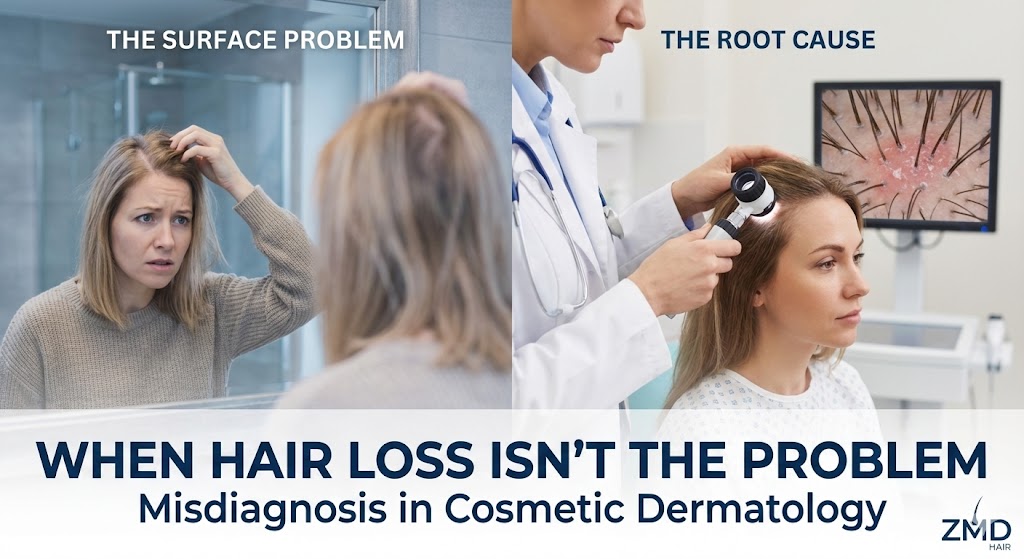
If you’ve ever Googled “creatine hair loss,” you’re not alone. This question floods fitness forums and social media, yet the answer is far more nuanced than a simple yes or no. The short version: creatine has not been proven to directly cause hair loss, but there is one plausible biological pathway worth understanding before you scoop.
Below, ZMDHair’s team breaks down the only relevant study, the DHT connection, and what it realistically means for people who are already genetically predisposed to thinning hair.
The One Study Everyone Cites — and Its Limitations
Nearly every creatine-and-hair-loss conversation traces back to a single small study published in the Clinical Journal of Sport Medicine in 2009. Researchers looked at college-aged rugby players in South Africa and found that those who took creatine monohydrate for three weeks showed a significant rise in serum dihydrotestosterone (DHT) — roughly a 56% increase — compared to a placebo group, though testosterone itself did not change meaningfully. DHT is the androgen most strongly linked to androgenetic alopecia, the hereditary pattern hair loss that affects millions of men and women.
Here’s the critical context: the study measured DHT levels in the blood, not hair follicle miniaturization or actual hair shedding. It was small, short, and has not been independently replicated in a robust way. No peer-reviewed study has directly demonstrated that creatine supplementation causes measurable hair loss in humans. That gap between a hormonal signal and a clinical outcome matters enormously.
Understanding DHT and Androgenetic Alopecia
DHT (dihydrotestosterone) is a potent androgen derived from testosterone via the enzyme 5-alpha reductase. In people who carry a genetic sensitivity in their hair follicles, DHT gradually shortens the follicle’s growth cycle, causing hairs to become finer and shorter over successive cycles — a process called miniaturization. This is the root mechanism behind male-pattern and female-pattern hair loss.
Critically, elevated DHT only accelerates hair loss in individuals who are genetically susceptible. Someone without the follicular sensitivity can have higher DHT levels and experience no meaningful change in hair density. This is why the creatine-DHT finding, even if reliably reproducible, would not be equally relevant for everyone.
Who Might Actually Be at Risk?
If you have a strong family history of pattern hair loss — particularly on your maternal grandfather’s side or your father’s side — your follicles may already be primed to respond to DHT. In that context, any sustained elevation in DHT, from whatever source, could theoretically accelerate a process that was already underway. Creatine supplementation may represent one variable in a larger hormonal picture.
Other factors that influence DHT levels and hair loss risk include:
- Age and hormonal shifts over time
- High-dose anabolic steroid use (a far more established DHT driver)
- Certain medications and health conditions
- Chronic stress and nutritional deficiencies
If you notice increased shedding after starting creatine, that timing may or may not be causal — but it is a reasonable signal to discuss with a physician.
What the Broader Evidence Says About Creatine Safety
Outside of the hair-loss question, creatine monohydrate has one of the strongest safety profiles of any sports supplement. Decades of research support its efficacy for short-burst athletic performance and muscle recovery, and major sports medicine organizations generally regard it as safe for healthy adults at recommended doses. Kidney concerns that circulated years ago have largely not been supported in people with normal renal function.
The honest summary is this: creatine is not a proven hair-loss trigger, but the DHT pathway is biologically plausible enough that individuals with significant genetic risk for androgenetic alopecia should be aware of it. That awareness is not the same as a verdict.
When to Talk to a Hair Restoration Specialist
If you are noticing a receding hairline, diffuse thinning at the crown, or increased shedding — whether or not you use creatine — the most productive step is a professional evaluation. Pattern hair loss is progressive, and earlier intervention consistently yields better outcomes. A double board-certified specialist like Dr. Hootan Zandifar at ZMDHair can assess your scalp, review your family history, and help you understand whether what you’re seeing is androgenetic alopecia, a nutritional issue, a stress response, or something else entirely.
Stopping creatine on its own is unlikely to reverse established hair loss if a genetic predisposition is driving it. Conversely, if your hair is stable and your family history is minimal, the existing evidence does not justify abandoning a supplement that may genuinely benefit your training. Personalized guidance from a qualified physician beats generalized internet advice every time.
Concerned about hair loss?
Talk with Dr. Hootan Zandifar — Beverly Hills & Santa Monica.
Frequently Asked Questions
- Does creatine directly cause hair loss?
- No study has directly shown that creatine causes hair loss in humans. One small study found elevated DHT levels in creatine users, and DHT is associated with pattern hair loss, but that is not the same as proving creatine makes hair fall out. Genetic susceptibility plays a major role.
- Should I stop taking creatine if I'm worried about my hair?
- If you have a strong family history of pattern hair loss and are concerned, it is reasonable to discuss creatine use with your physician or a hair restoration specialist. Stopping creatine may reduce one potential DHT variable, but it will not reverse hair loss that is already genetically driven.
- Are there hair loss treatments that work alongside ongoing creatine use?
- Yes. FDA-approved options like minoxidil and finasteride, as well as procedures such as hair transplantation, address hair loss through mechanisms unrelated to creatine. A specialist can help you weigh options based on your specific situation.
- How do I know if my hair loss is genetic or caused by something else?
- A board-certified hair restoration physician can evaluate your scalp, pattern of loss, medical history, and family background to identify the likely cause. Blood work can also rule out thyroid issues, nutritional deficiencies, and hormonal imbalances that contribute to shedding.